

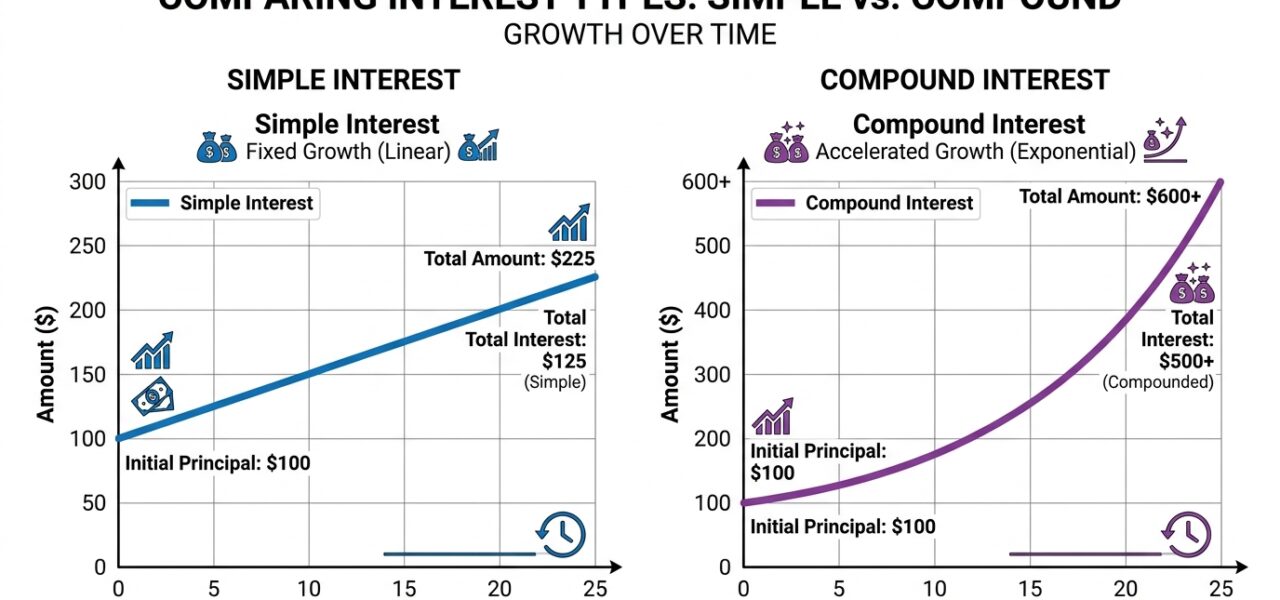
Interest is the fundamental mechanism of borrowing and saving — the price you pay for using someone else’s money, or the reward you receive for lending yours. Yet not all interest operates the same way. Simple interest and compound interest represent two fundamentally different mathematical approaches to calculating that cost or reward, and understanding which one applies to any financial product you use is essential for making accurate financial decisions. The difference between these two methods can amount to thousands of dollars over the term of a loan or investment.
Simple Interest: Linear Growth
Simple interest is calculated exclusively on the original principal — the amount initially borrowed or invested. The interest earned or owed in each period is a fixed percentage of that original amount and never changes as long as the principal does not change. The formula is straightforward:
Simple Interest = P x r x t
P = Principal
r = Annual interest rate (as a decimal)
t = Time in years
Example: You deposit $5,000 at 5 percent simple interest for 3 years. Interest = $5,000 x 0.05 x 3 = $750. Total value after 3 years = $5,750. Note that the interest is the same in Year 1, Year 2, and Year 3 — always $250 per year — because it is always calculated on the original $5,000.
Simple interest produces linear growth: plot it on a graph and you get a straight line. It is predictable, easy to calculate, and easy to understand. It is commonly used for car loans, personal loans, and some government bonds.

Compound Interest: Exponential Growth
Compound interest, as we have established, is calculated on the principal plus all previously accumulated interest. The interest earned in each period becomes part of the principal for the next period — meaning you earn interest on your interest. This produces exponential growth: the longer the time horizon, the more dramatically the compound growth curve diverges from the simple interest line.
Example with the same numbers: You deposit $5,000 at 5 percent compound interest (compounded annually) for 3 years.
Year 1: $5,000 x 0.05 = $250 interest. Balance: $5,250.
Year 2: $5,250 x 0.05 = $262.50 interest. Balance: $5,512.50.
Year 3: $5,512.50 x 0.05 = $275.63 interest. Balance: $5,788.13.
Total compound interest: $788.13 versus simple interest of $750. The difference of $38 seems small at 3 years. But extend the timeline to 30 years and the same $5,000 at 5 percent produces $20,799 with compound interest versus $12,500 with simple interest — a difference of $8,299 from the same initial investment.
Side-by-Side Comparison at Different Time Horizons
| $10,000 at 7% per year | Simple Interest | Compound Interest (Annual) | Difference |
|---|---|---|---|
| After 1 year | $10,700 | $10,700 | $0 |
| After 5 years | $13,500 | $14,026 | $526 |
| After 10 years | $17,000 | $19,672 | $2,672 |
| After 20 years | $24,000 | $38,697 | $14,697 |
| After 30 years | $31,000 | $76,123 | $45,123 |
When Each Method Is Commonly Applied
Simple interest is typically used for: Auto loans and personal installment loans (the amortization uses simple daily interest calculation), some government savings bonds, peer-to-peer lending in some jurisdictions, and short-term business loans where the principal is repaid in a lump sum at maturity.
Compound interest is typically used for: Savings accounts and high-yield savings accounts (compounded daily or monthly), certificates of deposit (CDs), mortgage interest (compound basis but with amortizing payments), credit card balances (compounded daily — strongly working against you), investment account returns (reinvested dividends compound over time), and retirement accounts such as 401(k) and IRA where the power of compound growth over decades is the entire investment thesis.

When Compound Interest Works Against You
The same mathematical mechanism that makes compound interest a powerful wealth-building tool makes it a destructive force when it is working against you as a borrower. Credit card companies compound interest daily — dividing your annual percentage rate by 365 and applying that daily rate to your average daily balance. On a $5,000 balance at 24 percent APR, the daily interest charge is approximately $3.29. This accrues 365 days per year, and any unpaid interest becomes part of next month’s balance on which new interest is charged.
The practical advice is consistent and unambiguous: use compound interest as a wealth-building tool through savings and investment accounts that compound in your favor, and eliminate all high-interest debt that compounds against you as the highest financial priority. These two goals — investing and eliminating high-interest debt — are not competing priorities. Paying off a 24 percent credit card is a guaranteed 24 percent return on your money, which no legitimate investment can promise.
This article is for educational purposes only and does not constitute financial advice. Please consult a qualified financial professional for personalized guidance.